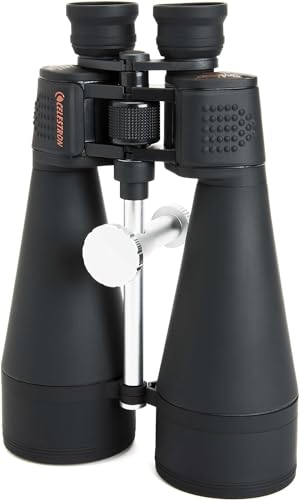
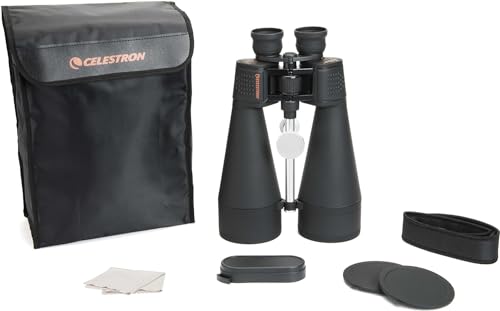
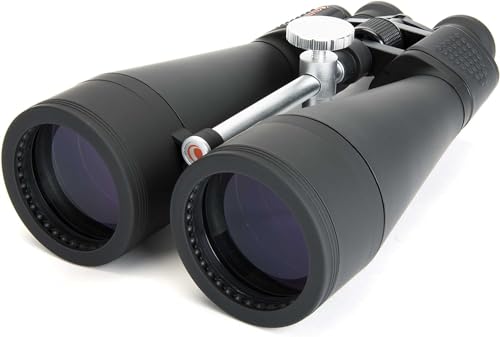
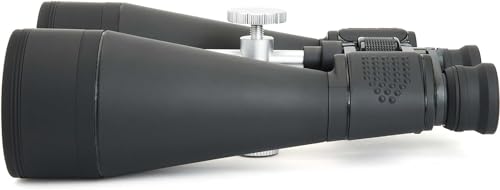
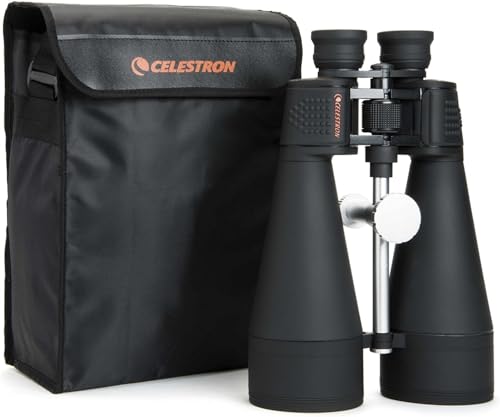
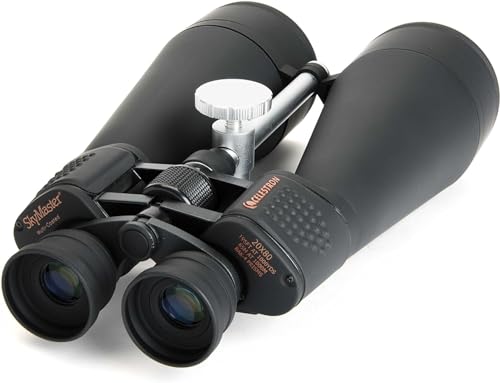

🌌 Unlock the Universe: See More, Miss Less with SkyMaster 20X80!
The Celestron SkyMaster 20X80 Binoculars feature powerful 20x magnification combined with massive 80mm objective lenses and fully multi-coated optics, delivering bright, sharp views ideal for astronomy and terrestrial use. Designed for serious beginners and enthusiasts alike, these binoculars offer adjustable focus settings and tripod compatibility for stable, immersive stargazing experiences. Weighing 2.1kg, they excel in revealing deep sky objects, planets, and detailed lunar surfaces, making them a top-tier value in their price range.


| ASIN | B0007UQNTU |
| Batteries Included | No |
| Batteries Required | No |
| Best Sellers Rank | #255,712 in Electronics ( See Top 100 in Electronics ) #334 in Binoculars |
| Brand | Celestron |
| Compatible Devices | Tripod, Camera, Smartphone Adapter |
| Customer Reviews | 3.9 3.9 out of 5 stars (3,431) |
| Date First Available | 24 March 2012 |
| Does it contain liquid? | No |
| Generic Name | Binocular |
| Has Image Stabilisation | No |
| Has a tripod mount | No |
| Imported By | A&S Creations, 6/7, Ground Floor, West Patel Nagar New Delhi-110008 |
| Importer | A&S Creations, 6/7, Ground Floor, West Patel Nagar New Delhi-110008 |
| Includes AC Adapter | No |
| Includes Rechargeable Battery | No |
| Is there a timer? | No |
| Item Dimensions LxWxH | 22.9 x 11.9 x 0.1 Centimeters |
| Item Weight | 2 kg 180 g |
| Item model number | 71018 |
| Lens type | Objective Lens |
| Manufacturer | Celestron |
| Material | Rubber |
| Maximum magnification | 20 x |
| Min Focal Length | 328.6 Millimeters |
| Model | 71018 |
| Model Name | celestron |
| Model Year | 2012 |
| Mounting Hardware | Binocular | Objective lens caps| Rainguard| Carrying case| Neck strap| Lens cloth| Instruction manual |
| Mounting Type | Tripod Mount |
| Net Quantity | 7 Count |
| Number of items | 1 |
| Optical zoom | 20 x |
| Packer | A&S Creations, 6/7, Ground Floor, West Patel Nagar New Delhi-110008 |
| Product Dimensions | 22.86 x 11.94 x 0.1 cm; 2.18 kg |
| Special Features | Water-resistant |
A**A
GREAT FOR ASTRONOMY!
First thing first, delivery service, packaging was great. This is my first binoculars ever. So I can't say if this piece is completely out of collimation (will give updates once I check). Pros: 1. Well built. 2. Fully multicoated optics. 3. Value for money. 4. Best for beginners in Astronomy. Cons: 1. Quality of the bag provided is not good. (substitute would be a DSLR camera backpack and it will do the job). 2. Collimation could be a problem. (Almost all heavy binos have this error). You can fix it yourself or could ask for a replacement. In detail:- 1). You cannot get this quality at this price. Compare with ORION 20X80 --- which is around ₹ 25k. 2). If you cannot decide about getting 20X80 or other smaller binos then I would say 20X80 would be better. It has a larger objective of 80mm which increases your limiting magnitude to approx +7(with naked eyes your limiting magnitude is around +1). That's a huge difference. You will be able to see most of the messier objects and other DSOs apart from Moon, planets, and Orion nebula. 3). It is literally a pair of two small telescopes😉. A telescope equivalent to these binoculars will be above ₹ 30k (trust me), So this is a great deal. Some important points: 1). You can adjust the interpupillary distance. (As any other binoculars have) 2). You can adjust the dioptre setting (for individual focus adjustment for eyes) by rotating the right eye piece. (please Google for more information) 3). Centre focus wheel is given. ( For focusing at different distances) (All above three adjustments could be stiff in the starting) Suggestion for Tripod: 1). A fluid head tripod is a must (for smooth and precise maneuvering of binoculars). 2). Tripod must be heavy (to keep binoculars steady/ 20X magnification is too much). 3). A branded tripod is not required. 4). I will suggest getting a tripod from a photo store. (If it's in your budget then Manfrotto fluid head tripod will be the best) An Update: 1). Saturn's ring is visible. It will need a nice focus and patience. 2). The object should be at the center of the field of view to avoid chromatic abrasion. 3). Four of Jupiter's moon are visible. You can not make out the Great Red spot. 4). After watching planets for an hour, I found my binoculars are perfectly collimated. 5). Bright objects (-2 magnitude or higher) will give chromatic abrasion. 6). You will be able to see stars as dim as +8 magnitude in a light-polluted sky. 7). Andromeda galaxy will cover your entire field of view on a very dark night. 8). Many DSOs around the Sagittarius constellation are visible from these binoculars. 9). The field of view is around 2.6° and not 3.7° as mentioned. 10). The moon looks breathtakingly beautiful. It will appear three dimensional with these giant binoculars. You can make out Apollo missions' landing sites to a precision of few kilometers. 11). Orion Nebula will be visible bright and crisp. Your field of view will be contain just the Orion sword. 12). If you are willing to do astrophotography using these binoculars then you will need a smartphone adapter for binoculars (just search for it and you will find it on amazon) and a photo staking software - DeepSkyStacker which will stack together hundreds of shots of a DSO and after few hours of processing, you will get a bright and detailed astrophotograph. 13). Neptune and Uranus are visible just like a dot but you can make out their color. Best at this price!! Clear skies!!
C**J
The best you can get!
Guys, this is a honest review. I bought it for 13500 INR combined price on 12th of july 2020 along with digitek 880 pro tripod, in conjunction they work fabulous. I have used it for a month and a half till now, since I had early experience with star charts , star gazing apps and nautical astronomy from my college, it became easier for me to do binocular astronomy with these huge ones! Trust me, I belong to Hyderabad rated class 9 on bortle scale and I have seen upto 10 dso's which obviously looked faint due to light pollution at my place. We can easily make out Jupiter and its four moons. No offense but Jupiter looks just like a bright dot. Saturn's disk can just be identified under keen focus. Sunset visuals and the moon looks breathtaking awesome! I was also able to see Neptune as a red faint dot. I have also used them for bird watching (eagles) and terrestrial spying too. These activities are always fun with them. Every experience through celestron skymaster 20by80 will widen your eyes open. It is not so big as 25by100 and also not so small, being perfect for an amateur astronomer, tripod is compulsory(as they weigh 2.1kg)! A photography tripod works best. Handle them with care and they may serve you many years and I can't wait to get to a dark night sky and visualize milky way through this binoculars. Get a mobile adapter and adjust your camera settings to capture amazing images of celestial objects. As far as I know, this is the best binocular you will get at a cheaper price of best quality. Happy stargazing and clear skies!
A**R
Defective product
Received defective product, requested for refund
R**D
Value for money binoculars.
The binoculars arrived in good condition and they were properly collimated. These binoculars are relatively lightweight for their size; don't mistake me, they are not meant for hand-holding. They need to be mounted on a sturdy tripod. I am using it on my Gitzo tripod + Markins ball head; works good. Positives: Physically they seem to be fairly sturdy. The objective diameter is 80 mm as advertised. They seem to be multi-coated; they show a pale green reflection against light. The inside of the barrel is corrugated and properly blackened. The exit pupil is well rounded. There is no cutoff of exit pupil, nor there is any detectable vignetting/light fall off. I viewed many deep sky objects with these and thoroughly enjoyed the view. Negatives: Brighter stars not pin-points even at the center of the field, they exhibit spikes like diffraction spikes of a newtonian. But for fainter starts this is a non-issue. The rubber eye-cups are a bit hard. For my interpupillary distance the eye-cups are so close that I cannot fit my nose between the eye-cups. Hence I am not able to place my eyes close enough to get a full field of view with eye-cups up. When I fold down the eye-cups I can enjoy the full filed of view. The eye relief does not seem to be 18 mm as advertised, It seems to me closer to 12 - 14 mm. I have not measured it though. The filed of view is close to 3.2 deg, not 3.7 deg as advertised. There is colour fringing on brighter stars. I haven't had an opportunity to view moon through them. When mounted on tripod, even after the top knob is fully tightened, the binocular yaws a bit to left or right. Finally, the bag supplied is of poor quality. It does not provide much protection to the binoculars. Still, these a pair of good binoculars, capable of providing hours of joyous deep-sky views under dark skies. They are value for money.
S**R
Upgraded my SkyMaster 15x70 binos to the 20x80 model. This review concerns astronomical use, especially as it relates to casual observation. I just returned from two evenings with it under the dark skies of WV's Monongahela National Forest 1) Field of view offers wide angle eye candy. 3.7 degrees with the feeling of expansiveness--even at 20x. I could place Orion's belt in one view; Orion's sword in another; The entire Pleiades (M45) in one glimpse; much of Kemble's Cascade; nearly all sections of the Veil Nebula complex; The Lagoon (M8) and Trifid Nebulae in one field; Can almost place M7 with M6 in Scorpius in the same field, also the Coathanger asterism fits nicely into the field of view. 2) Spectacular views offered of M7 near the Scorpion's tail, The Swan nebula (M17), Dumbbell Nebula (M27), a billowing Orion Nebula (M42), Pleiades (M45), Andromeda Galaxy (M31) with companion galaxies...can seem to infer some stars on the outskirts of globular clusters M13 (Hercules) and M22 (Sagittarius). Veil Nebula is breathtaking under dark sky (t5he western side resembles a fuzzy fish hook). Can see North American Nebula near Deneb at top of Cygnus. I returned to several of these again and again--so rewarding were the views. I set it up a week ago for a backyard star party and the Pleiades was really impressive for viewers as was the Perseus Double Cluster and Albireo double star. The Orion nebula is also magnificent. 3) Generous Eye Relief is best utilized by folding the eyecups back 4) Used a 30 year old aluminum camera tripod that is sturdy enough to hold the 20x80 with ease. How I found it effective was to sit in a wooden kitchen table chair with the tripod legs fully extended and tripod close in with bino eye cups folded back. My tripod has a shaft that can rise about 10 inches more so I used that incrementally as viewing angle was increased--not unlike a barber's chair raising or lowering. Ample eye relief coupled with the folded back eye cups and raised tripod slant the bino was attached to meant I could view objects 45 degrees up from the horizontal. Objects near vertical I could manage limited viewing by actually leaning back with binos and tripod legs laying across me. That's how I viewed the Veil Nebula. Be mindful of the weight before trying this!! It was OK for me but may not be for you. Test that carefully. The 20x80 mount is more robust than the attachment I used with the same tripod with the 15x70's. 5) Clarity of image was NOT sharp all the way to the edge. However, for the comparatively low price of the 20x80 I really can't complain about this as I'd pay much more for that level of optics. 6) I have an 11" SCT telescope. The 20x80 is a nice, satisfying casual alternative to setting up my larger scope and I had so much fun with it one evening I never bothered to set up my SCT. 7) These binos are HEAVY so a sturdy tripod is recommended. The 20x80 is significantly heavier than my 15x70 set. I can use each hand held on their own for limited viewing by gripping the large ends with each hand. 8) The moon is not excessively bright as it tends to be telescopically so you need not be overly concerned about temporary "blindness" from viewing the moon then switching to other stellar objects. Eye recovery is but momentary. 9) Did finally view Jupiter. The line up of the moons is more as one sees telescopically rather than with traditional binocular views. Be advised that surface brightness is so great one will likely NOT be able to the bands on Jupiter. Mars and Jupiter are definitely bright discs. haven't yet had a good look at Saturn as its currently near the sun in the sky.
J**A
Son los mejores binoculares que he tenido , para observaciones astronómicas son una maravilla, respecto al envío todo muy bien buena protección
Y**D
Excellent. You can see many stars and constellations.
V**L
I thought that the magnification is really good
B**O
O que dizer de um binóculos que traz as maravilhas do céu até seus olhos? Alguns meses atrás comprei um 7x50 da mesma marca e após varrer boa parte do céu, senti a necessidade de um upgrade. Apesar de o 15x70 ser mais barato, resolvi ir de vez atrás de um maior e deparei com esse 20x80. Arrependimento? Apenas com o tempo de espera até chegar, passou pouco mais de 1 mês até ter em mãos. Já o binóculos em si é sensacional, não tem comparação com meu 7x50 quanto à observação do céu. Obviamente não é possível ver detalhes dos planetas, mas Titã é visível, Saturno aparece como uma luz alongada e Júpiter é majestoso com seus maiores satélites, imponente no campo de visão! Notam-se muitas crateras e montanhas na Lua com uma qualidade incrível! Além disso é possível ver também aglomerados estelares, nebulosas e algumas galáxias, porém dependem pelo menos de um céu rural. Falando em nebulosas, a Carina e a de Órion são as mais lindas para se ver, na minha opinião. Para se ter uma ideia do que é possível enxergar, no centro de onde moro cheguei a identificar, com muito custo, estrelas até da magnitude +10.2, sendo mais fácil identificar até mais ou menos +9.5. Já objetos menos densos, como nebulosas e cometas, dependem muito da poluição luminosa e não chegam a tal magnitude. Como nem tudo é perfeito, há alguns pontos negativos: 1° - a aberração cromática é bem forte nos objetos mais brilhantes, mas não chega a comprometer a experiência. 2° - por mais que na embalagem diga que serve para visualização terrestre de longa distância, não gostei da falta de nitidez nos morros ao longe. Nesse quesito ainda prefiro meu 7x50. No geral, é um equipamento indispensável e ótima alternativa aos telescópios baratos. Mas tenha em mente que é praticamente exclusivo para astronomia.
Trustpilot
3 weeks ago
3 weeks ago


